How AI Supports Special Education in Rural School Districts (Tools, Use Cases, and Measurable Impact)
How rural special education teachers use AI tools like Immersive Reader, Read&Write, Diffit, and MagicSchool to save time and improve access.
3/2/20266 min read
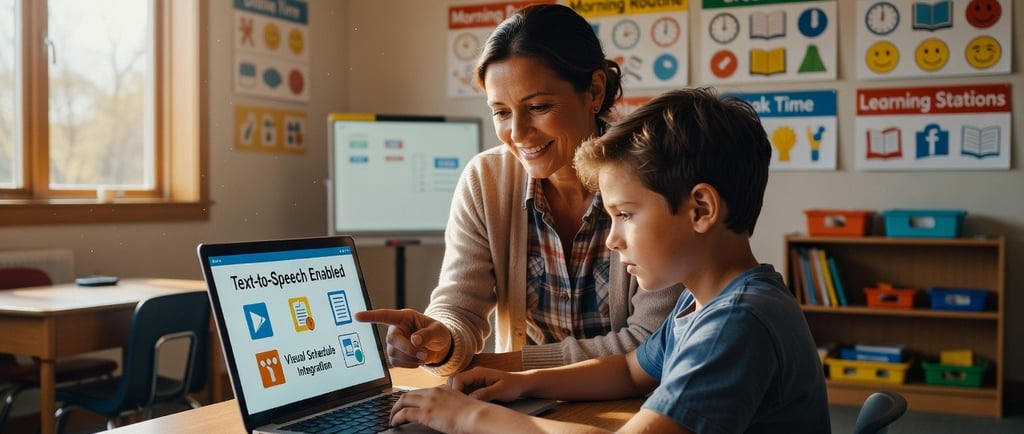

Special education in rural districts is a high-stakes juggling act: fewer staff, fewer specialists (speech, OT/PT, behavioral supports), long travel distances, and technology constraints that range from “old laptops” to “internet that disappears when it rains.” The result is that rural SPED teachers often cover multiple grade bands, handle heavy documentation loads (IEPs, progress monitoring, accommodations), and still have to deliver instruction that’s individualized and legally defensible. The rural SPED reality checklist limited staffing, fewer specialists, students spread across grades, older devices, slower internet, high caseloads matches what rural educators repeatedly describe on the ground.
And the staffing side isn’t imaginary: federal and research organizations have documented that shortages hit special education especially hard, with schools reporting SPED vacancies and difficulty filling them in recent years. Rural schools also face broader recruitment problems and limited pipelines for qualified educators, which makes it harder to provide consistent services for students with disabilities. That’s the gap AI is starting to help close not by “replacing teachers,” but by stretching the capacity of the staff who are already there, so students get accommodations, access to content, and consistent practice even when the district can’t hire every specialist it wants.
The first place AI makes an immediate, measurable difference in rural SPED is accessibility: getting students into the same learning material as everyone else without waiting for someone to rewrite everything by hand. That’s where text-to-speech (TTS) and “read aloud” tools matter. In practice, rural teachers commonly use Microsoft Immersive Reader (built into many Microsoft/OneNote/Edge workflows), Read&Write, and similar supports to read passages aloud, highlight as it reads, support adjustable speed, and reduce cognitive load for students with decoding challenges.
Research evidence here is better than people think: a widely cited meta-analysis on TTS/read-aloud tools found a positive effect on reading comprehension for students with reading difficulties (average effect size around d = .35, statistically significant), which is a meaningful improvement in education research terms especially when it’s applied daily as an accommodation rather than as a one-off intervention. One large school-based study (10-week implementation) also found significant positive effects on reading vocabulary and comprehension after students used TTS software (minutes of use tracked), suggesting that consistent exposure matters. The “with vs without” difference rural teachers see looks like this: without TTS, students with dyslexia/LD may avoid grade-level text or stall out; with TTS, they can access the same passage, answer questions, and participate in discussions even if decoding is the barrier. That’s not just convenience it’s instructional access.
The second big rural SPED use-case is rapid differentiation and leveling of content, because rural teachers don’t have extra planning periods (or extra staff) to rewrite every worksheet for every reading level. This is where tools like Diffit and educator-focused generators like MagicSchool AI show up in real classrooms. Diffit’s core workflow is simple and practical: paste a passage (or a link) → choose a target reading level → generate a leveled text, vocabulary supports, and comprehension questions. For a rural SPED teacher, the “how it’s used” is usually not students sitting on devices all day; it’s the teacher using AI off to the side to create printable leveled versions and then running small-group instruction. This is especially useful in low-tech environments: AI can generate resources that get printed and used offline (simplified worksheets, picture schedules, graphic organizers), which matters when device access is limited or internet is unreliable.
“With vs without” here is basically time and consistency: without tools like Diffit, leveling is slow and inconsistent (or doesn’t happen); with Diffit, teachers can generate multiple levels of the same text quickly, keeping the class aligned on the same topic while still meeting IEP needs. And because rural SPED classrooms often mix grade levels, this is the difference between “one-size-fits-none” and actually having materials that match student ability.
Third: IEP paperwork and progress monitoring the stuff that quietly eats rural teachers alive. AI shouldn’t write an IEP for you (and districts should never paste student-identifying info into random chatbots), but it can help draft structures that teachers customize: measurable goal wording, data sheet templates, parent-friendly explanations, accommodations lists to consider, and progress note language. Used this way, AI reduces hours of paperwork while leaving final decisions to professionals.
The rural benefit is amplified because staffing shortages mean the remaining educators are covering more roles. National reporting has noted that special education shortages lead to vacancies and underqualified staffing in many places, which increases caseload pressure on qualified teachers who remain. In real-world use, an educator-focused platform like MagicSchool AI is positioned as “district-aligned” and built for educator workflows, which is often why teachers prefer it over general-purpose chatbots: it’s designed around classroom tasks and guardrails, which matters in SPED settings. “With vs without” impact here is mostly time: without AI assistance, a teacher may spend evenings on documentation; with it, the teacher can generate a draft progress monitoring template or accommodation explanation in minutes, then edit and finalize. Less burnout isn’t a “soft benefit” in rural districts it’s retention.
Fourth: speech and language support when specialists are scarce, which is especially relevant in rural districts that can’t always hire or retain speech-language pathologists (SLPs). The shortage is documented: multiple organizations tracking special education staffing have reported shortages in related service providers like SLPs. AI tools don’t replace an SLP, but they can provide structured practice between sessions: speech-to-text for reducing writing barriers, guided practice for vocabulary and sentence structure, and pronunciation feedback tools depending on what the district allows. Options include Speechnotes and other speech-support tools for daily practice, and that’s consistent with how rural teachers use them: short, repeatable routines that keep skill practice consistent even if the SLP is itinerant and only visits weekly or monthly.
The “with vs without” difference in rural speech support is access: without these tools, practice may happen only when the specialist is present; with them, students can get daily reps (with teacher supervision) that reinforce therapy goals.
Fifth: behavioral and social-emotional learning (SEL) supports because rural SPED classrooms often have fewer paraprofessionals and fewer behavior intervention resources, making structured systems essential. AI-powered or AI-assisted SEL tools like Microsoft Reflect, check-in platforms, and mood-tracking routines can help students label emotions, reflect, and build routines for self-regulation.
The rural advantage is not that AI magically “fixes behavior,” but that it creates a consistent data trail and a consistent language for check-ins, which helps a small staff notice patterns: “Mondays after lunch,” “during transitions,” “after loud environments,” etc. Teachers can then match supports break schedules, task chunking, sensory tools more precisely. Without structured SEL tools, rural teachers often rely on memory and scattered notes; with them, it’s easier to coordinate with families and support teams, even if the “team” is basically the teacher plus one counselor who covers three schools.
Sixth: autism/ADHD supports and executive-function scaffolding, where AI is used to generate individualized visuals and step-by-step supports quickly. In practice, rural teachers use AI to create: personalized social stories, task analyses (“first, then, next”), visual schedules, reinforcement charts, simplified directions, and multiple versions of assignments.
That’s not glamorous, but it’s incredibly high-impact: students who struggle with transitions, comprehension, or working memory perform better when instructions are explicit and consistent. “With vs without” here is often the difference between a student melting down because the task feels ambiguous versus a student completing it because the steps are clear. Rural schools benefit because these supports can be created across buildings, reducing duplication. If a district has only one SPED teacher for multiple grades, reusable AI-generated templates become a practical survival tool.
Seventh: low-tech and offline-friendly deployment, which is the make-or-break factor for rural districts. AI isn’t only “kids on Chromebooks.” Rural SPED teachers frequently use AI like a behind-the-scenes prep assistant: generate differentiated texts → print packets; generate picture supports → laminate; generate modified quizzes → small group; generate parent letters → send home. Even without strong internet, teachers can use AI to prepare printed materials, simplified worksheets, flashcards, visuals, and step-by-step instructions.
This is also why tools with simple workflows (Diffit’s paste-and-level approach, or MagicSchool’s educator task templates) tend to get adopted faster than complex platforms. “With vs without” in low-tech rural districts is basically: without AI, materials are often generic and delayed; with AI, materials are customized and ready even if students never touch a device.
Impact and realism: the strongest quantified evidence is currently around assistive reading supports like TTS and related read-aloud tools improving comprehension for students with reading difficulties, with meta-analytic results showing a positive average effect and multiple studies supporting gains under certain conditions. For broader “AI lesson generator” tools (Diffit/MagicSchool), the measurable outcomes are often captured more as time saved plus increased differentiation frequency rather than standardized achievement gains, because schools don’t always run controlled studies on teacher workflow tools. Still, the logic chain is strong in rural SPED: when staffing is tight (and it is, especially in special education), tools that increase differentiation and reduce paperwork can increase the amount of individualized instruction delivered and keep teachers from burning out and leaving. The “with vs without” story we can responsibly claim is: with AI supports, rural SPED teachers can deliver more accessible materials, more consistent accommodations, and more frequent practice especially using evidence-supported accessibility tools like TTS while reducing planning and documentation overload. Without them, the same teachers are forced into triage mode, and students feel the consequences as reduced access and inconsistent supports. That’s not hype; it’s basic capacity math in a district where one teacher may be covering what should be a team.
Contact
Get in touch
Get teacher-friendly AI tips
info@teacheraidaily.com
© 2026 Teacher AI Daily. All rights reserved.