How Artificial Intelligence Is Transforming Agriculture Education and Modern Farming
This article explains how artificial intelligence is transforming agriculture education by strengthening scientific learning, improving farm logistics, and supporting economic decision-making, while showing how AI is applied in real agricultural teaching environments.
1/5/20267 min read
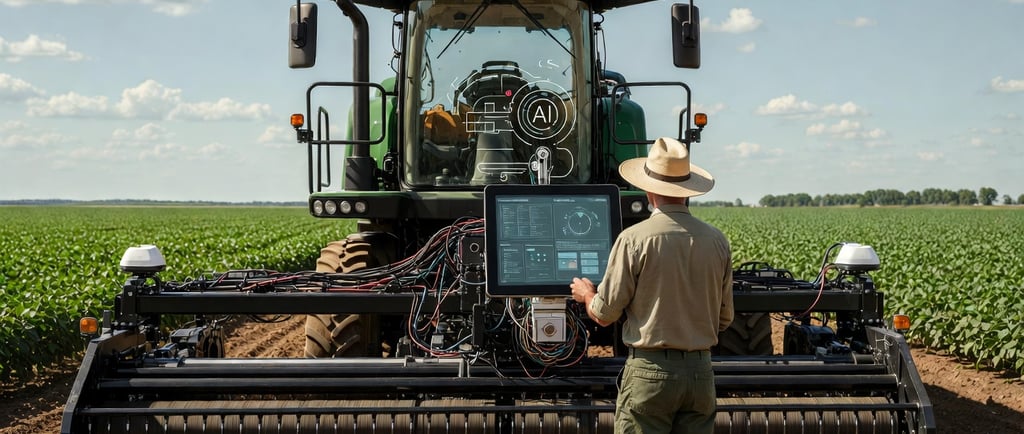
Agriculture has always been a science rooted in observation, experimentation, and adaptation. Over time, advances in soil science, genetics, irrigation, and mechanization reshaped how food is produced and managed. Today, agriculture is entering another transformation driven by artificial intelligence. For college lecturers teaching agriculture, this shift is not simply about new tools but about preparing students to understand farming as a complex, data-driven system that blends biology, technology, logistics, and economics. Artificial intelligence is increasingly used to enhance how agriculture is taught, researched, and applied, allowing educators to connect scientific theory with real-world agricultural decision-making in ways that were not possible before.
5 Simple AI Tools Every Rural Teacher Can Use (Even with Limited Tech)
In agricultural education, one of the greatest challenges lecturers face is explaining complex biological and environmental systems in a way students can truly understand. Concepts such as soil nutrient cycles, plant stress responses, pest population dynamics, and livestock productivity involve layers of interaction that can be difficult to visualize through textbooks alone. Artificial intelligence helps bridge this gap by allowing lecturers to translate dense scientific information into structured explanations that build understanding gradually. By using AI to model biological processes, interpret datasets, or simulate environmental conditions, lecturers can show students how changes in temperature, moisture, or nutrient availability affect agricultural outcomes over time. This approach strengthens scientific comprehension while keeping instruction grounded in real agricultural systems rather than abstract theory.
AI also plays an increasingly important role in helping agriculture students understand the scientific foundation of precision farming. Modern farms rely on data collected from soil sensors, satellite imagery, drones, and climate monitoring systems to make informed decisions about planting, irrigation, fertilization, and pest control. In the classroom, artificial intelligence allows lecturers to work with realistic datasets that mirror what students will encounter in professional agricultural settings. Instead of simply learning definitions, students analyze patterns, identify anomalies, and explore cause-and-effect relationships within agricultural data. This teaches them not only what precision agriculture is, but also how it actually functions in practice and why it improves efficiency and sustainability.
Beyond scientific understanding, agriculture education must also address the logistical complexity of modern farming operations. Farming is no longer limited to planting and harvesting; it involves managing timing, storage, transportation, labor, and resource allocation across entire production cycles. Artificial intelligence enables lecturers to demonstrate how logistical decisions affect crop quality, spoilage rates, and profitability. By examining AI-generated simulations of harvest timing, storage conditions, or transport delays, students gain insight into how small logistical missteps can lead to significant economic losses. This perspective helps students see agriculture as an interconnected system where scientific knowledge and operational planning must work together.
Economic literacy is another essential component of agriculture education that AI supports effectively. Farming decisions are influenced not only by biology and climate but also by fluctuating input costs, market prices, labor availability, and financial risk. Artificial intelligence allows lecturers to introduce students to realistic economic scenarios without exposing them to real financial consequences. By modeling farm budgets, forecasting market changes, or simulating weather-related losses, AI helps students explore how economic pressures shape agricultural decision-making. This integration of economics into agriculture courses prepares students to think strategically rather than reactively, an increasingly important skill in an unpredictable global food system.
For lecturers, one of the most practical benefits of artificial intelligence lies in how it supports course design and instructional planning. Agriculture courses often require extensive preparation, including field labs, data analysis activities, safety protocols, and assessments tailored to hands-on learning. AI helps lecturers streamline this preparation by assisting with the creation of structured lab instructions, clear learning objectives, and realistic case studies. Rather than replacing academic judgment, AI functions as a planning assistant that reduces repetitive workload while allowing educators to maintain control over content quality and rigor. This frees lecturers to spend more time engaging with students and refining instructional strategies.
Artificial intelligence also enhances how fieldwork is integrated into agriculture education. Field labs are essential for teaching soil analysis, crop identification, pest monitoring, and equipment operation, yet poorly structured field experiences can overwhelm students or waste valuable instructional time. By using AI to design observation guides, data collection templates, and safety checklists, lecturers can ensure fieldwork is focused, efficient, and aligned with learning goals. Importantly, AI support does not require constant device use in the field. Many lecturers use AI beforehand to generate printable materials, making these benefits accessible even in rural environments with limited connectivity.
In addition to supporting teaching and learning, artificial intelligence plays a growing role in research-informed agriculture education. Lecturers can use AI to summarize current agricultural research, compare findings across studies, and highlight emerging trends in sustainability, climate resilience, and food security. This helps students understand that agriculture is not static but continuously evolving in response to environmental and technological change. Exposure to AI-assisted research analysis prepares students for graduate study and professional roles where interpreting large volumes of information is increasingly necessary.
Another important dimension of AI in agriculture education is its ability to support diverse student backgrounds. Agriculture programs often include students with varying levels of prior experience, from those raised on farms to those encountering agriculture for the first time. Artificial intelligence allows lecturers to adapt explanations and learning materials without lowering academic standards. Concepts can be introduced in accessible language while still preserving scientific accuracy, ensuring all students can engage meaningfully with the material. This inclusive approach strengthens learning outcomes and encourages broader participation in agricultural fields.
Carrying out AI-supported agriculture education does not require advanced technical expertise or expensive infrastructure. In practice, lecturers begin by identifying areas where students struggle to connect theory with application, such as understanding data trends, managing complex processes, or evaluating economic trade-offs. AI is then used as a tool to clarify these areas through simulations, rewritten explanations, or scenario modeling. Lecturers review and adapt AI outputs to ensure they align with course objectives and ethical standards, maintaining academic integrity while benefiting from increased efficiency and clarity.
Ultimately, artificial intelligence functions best in agriculture education as a support system rather than a replacement for traditional teaching. Farming remains a discipline grounded in hands-on experience, observation, and human judgment. AI strengthens these foundations by improving how information is analyzed, presented, and applied. For agriculture lecturers, the value of AI lies in its ability to enhance scientific understanding, illuminate logistical complexity, and deepen economic reasoning, all while preparing students for a future where technology and agriculture are increasingly intertwined.
As agriculture continues to evolve in response to climate change, population growth, and technological innovation, education must evolve alongside it. Artificial intelligence offers lecturers a practical way to modernize instruction without abandoning the core principles that define agricultural science. When used thoughtfully, AI helps bridge the gap between classroom learning and real-world farming, ensuring the next generation of agricultural professionals is equipped with both knowledge and insight.
Real AI Use Cases in Modern Agriculture
1. CropWizard: The Generative AI Agronomic Tutor
CropWizard (developed by the AIFARMS Institute) is a leading example of how Generative AI serves as a 24/7 personal tutor for agriculture students. Unlike standard chatbots, this tool is trained on hundreds of thousands of university extension documents and peer-reviewed research papers. In an educational setting, students use CropWizard to simulate real-world advisory roles; they can upload a photo of a diseased plant or describe soil conditions, and the AI provides a detailed diagnosis with scientific reasoning. This teaches students how to interpret complex data and provides them with "expert-level" intuition that traditionally took decades to acquire in the field.
2. Digital Twins: Risk-Free Farm Management Simulations
A Digital Twin is a high-fidelity virtual replica of a physical farm, and it is perhaps the most powerful tool in modern ag-education. Platforms like Farmonaut allow students to manage a "virtual field" that reacts to real-time satellite data and weather patterns. By using these twins, students can experiment with different crop rotation strategies, irrigation schedules, or fertilizer applications to see the long-term results of their decisions in just minutes. This "accelerated learning" allows a student to witness the outcomes of ten simulated harvest seasons during a single semester, providing a deep understanding of sustainability and risk management without the financial risk of crop failure.
3. Minds-i Autonomous Tractors: Robotics & Edge Computing
To prepare students for the era of autonomous farming, educators are using student-scaled platforms like the Minds-i Autonomous Tractor. This tool brings the complex world of robotics into the classroom by allowing students to program "Edge AI"—intelligence that happens directly on the machine. Students learn to configure GPS, LiDAR, and computer vision sensors so the tractor can navigate rows, identify obstacles, and adjust its path in real-time. This hands-on experience is critical for teaching the technical side of the "Ag-Tech" workforce, moving beyond traditional mechanics into the realms of software engineering and sensor fusion.
4. Plantix: AI-Driven Mobile Disease Diagnosis
Plantix is an AI-powered "mobile agronomist" used globally to bridge the gap between classroom theory and field practice. Students use the app to identify over 600 types of plant pests and diseases simply by taking a smartphone photo. For education, it serves as an interactive field guide; the AI identifies the issue with over 90% accuracy and immediately provides a biological explanation of the pathogen. This tool is particularly transformative in regions with limited access to human experts, as it empowers students and smallholder farmers to become self-sufficient in crop protection and pest management.
5. Climate FieldView: Precision Data Visualization
Climate Field View is an industry-leading platform that has become a staple in university "Precision Ag" labs. It aggregates massive amounts of data from satellites, soil sensors, and connected machinery into a single dashboard. In an educational context, it teaches students how to read "Yield Maps" and "Variable Rate Prescriptions." Students learn to identify exactly why one corner of a field outperformed another by overlaying data layers like nitrogen levels, moisture, and seed density. This shift in education focuses on "spatial literacy"—the ability to understand that a field is not a uniform block, but a collection of distinct zones that require unique treatments.
6. IBM Watson for Agriculture: Predictive Analytics & Climate Modeling
IBM Watson provides students with tools for high-level predictive analytics and climate resilience training. By processing historical weather patterns and global climate models, students use Watson to predict future yield outcomes and potential "shocks" like droughts or floods months in advance. This tool is essential for teaching the "business" of agriculture; students learn to use AI-driven forecasts to make better financial decisions, such as when to sell grain or how to adjust planting dates to avoid early-season frost. It transforms the student from a reactive grower into a proactive manager of environmental and market risks.
Contact
Get in touch
Subscribe
info@teacheraidaily.com
© 2025. All rights reserved.