The Future of Homework: How AI Helps Students Learn Without Overwhelming Teachers
Discover how AI is transforming homework by making assignments more personalized, low-stress, and effective for students and teachers. Learn how AI tools simplify grading, provide instant feedback, support low-tech homes, and create meaningful learning experiences.
12/1/20253 min read
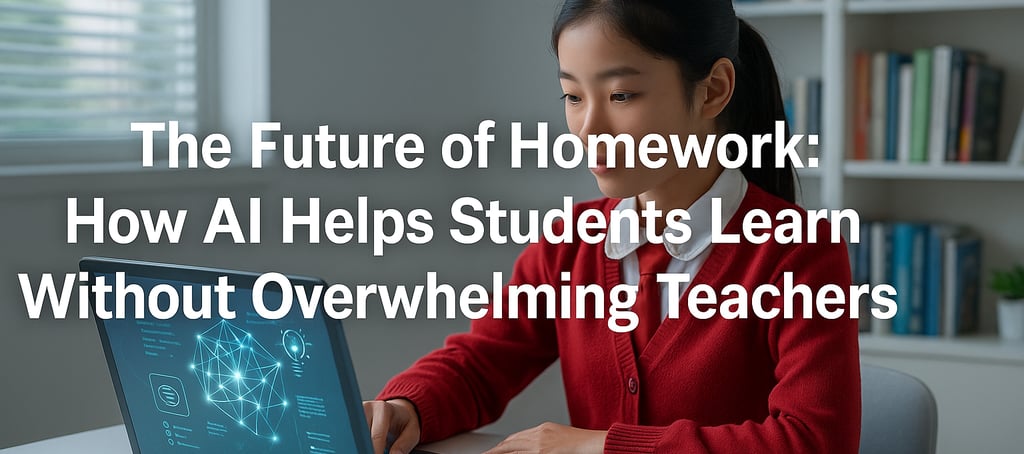
Homework has always been a delicate balancing act. Teachers need students to practice skills in order to grow, but too much homework can overwhelm families, add stress to students, and create hours of extra grading for educators. In many rural schools, where students may have limited access to devices or reliable internet service, homework becomes even more challenging to manage effectively. Artificial intelligence is beginning to reshape the homework experience by offering new ways to personalize practice, reduce stress, and simplify teaching without adding extra work for educators. Instead of relying on worksheets that feel repetitive or disconnected from student needs, AI allows homework to be flexible, meaningful, and accessible for all learners.
See also: How AI Improves Classroom Management and Reduces Behavior Problems Using Smart Tools
Traditional homework often misses the mark because many students complete assignments without fully understanding the content. Families sometimes struggle to help because teaching methods have changed, instructions may not be clear, and time at home is often limited. One-size-fits-all homework can leave advanced students bored and struggling students frustrated. Teachers also spend countless hours grading assignments, leaving them exhausted and behind on planning. To make matters worse, students typically don’t receive feedback on their homework until the next day or later reducing the value of practice. AI changes this by offering personalized support in real time, giving students the feedback and guidance they need to actually learn from their assignments.
One of the biggest breakthroughs AI provides is personalized homework. Teachers can ask AI tools to generate assignments with multiple difficulty levels so struggling learners, on-level students, and advanced students all receive exactly what they need. For example, a teacher can request fraction practice for fourth graders with versioned problem sets, visual models, step-by-step hints, and challenge questions. AI instantly produces differentiated homework that supports every child, allowing teachers to focus more on instruction and less on creating forty different versions of the same assignment. When students receive homework that matches their learning needs, frustration drops and understanding grows.
AI also offers students instant feedback without needing the teacher to sit beside them. Tools like Khan Academy’s AI tutor, PhotoMath, Socratic, ChatGPT, and MagicSchool’s practice generators allow students to ask questions, receive explanations, and get more support the moment they feel stuck. Instead of waiting until the next day to discover mistakes, they can learn immediately by asking the AI to walk them through a specific step or explain a concept in simpler terms. This helps students build independence, confidence, and clarity while reducing the stress that often comes with learning alone at home.
Families also benefit from AI-supported homework. Many parents struggle to assist with assignments because methods have changed or instructions are unclear. AI can give parents simplified explanations, visual models, translations, and step-by-step breakdowns that help them feel confident supporting their child. This eases the pressure on families and prevents homework time from becoming a nightly battle. Parents can focus on encouraging their children while the AI handles the complex explanations teachers normally would need to give.
AI even supports students who do not have access to devices or internet at home. Teachers can still use AI to prepare meaningful offline materials such as printable packets, leveled reading passages, vocabulary lists, writing prompts, math practice sheets, and graphic organizers. This allows rural schools and low-tech districts to benefit from personalized learning without relying on Wi-Fi or expensive technology. By combining AI-generated materials with traditional paper assignments, teachers can offer high-quality homework for every student, regardless of their home situation.
Homework becomes even stronger when teachers can track progress easily, and AI makes this possible. Platforms like Edulastic, Formative, and Google Classroom’s AI features automatically score assignments and create dashboards that show patterns of understanding, skill gaps, and common mistakes. This allows teachers to adjust lessons quickly instead of waiting weeks to review student work. When teachers can see what students are struggling with in real time, instruction becomes more responsive and effective.
AI also makes homework more engaging by generating creative assignments, gamified challenges, story-based tasks, and project-style work that motivates students. Instead of traditional worksheets, students can complete assignments that feel fun, interactive, and connected to the real world. This increased engagement helps even reluctant learners stay invested in their practice.
The true power of AI in homework is its ability to reduce stress while improving learning outcomes. Students receive instant support, clearer explanations, and more personalized help. Families get guidance without feeling overwhelmed. Teachers gain more time, less grading, better data, and more opportunities to focus on real instruction rather than paperwork. Homework becomes a tool that works with students instead of against them.
The future of homework is not about giving students more work it’s about giving them better work. AI makes this possible by transforming homework into a meaningful extension of the classroom instead of a stressful chore. Whether in rural communities, busy urban districts, or small classrooms with limited resources, AI has the potential to improve learning for every student and lighten the burden on every teacher. With the right balance, AI can turn homework into a positive, productive, and personalized learning experience that truly supports academic growth.
Contact
Get in touch
Subscribe
info@teacheraidaily.com
© 2025. All rights reserved.